Authority before action
Recommendations do not become operational changes without explicit authorization and the required approvers.
Catalyst Trust Center
Review the product boundary, data principles, pilot controls, and production exit evidence without separating trust from the decisions Catalyst is built to defend.
Trust is not a separate report. It is the evidence, authority, control, and outcome record behind each material decision.
Buyer security summary
Move between the working product, pilot configuration, data handling, and production acceptance without reading the entire security review first.
Catalyst demonstrates the complete accountability operating model with clearly labeled demonstration records.
Audience command views and decision queues
AI governance, Agent Gate, and evidence review
Decision policy, delivery lineage, and outcome verification
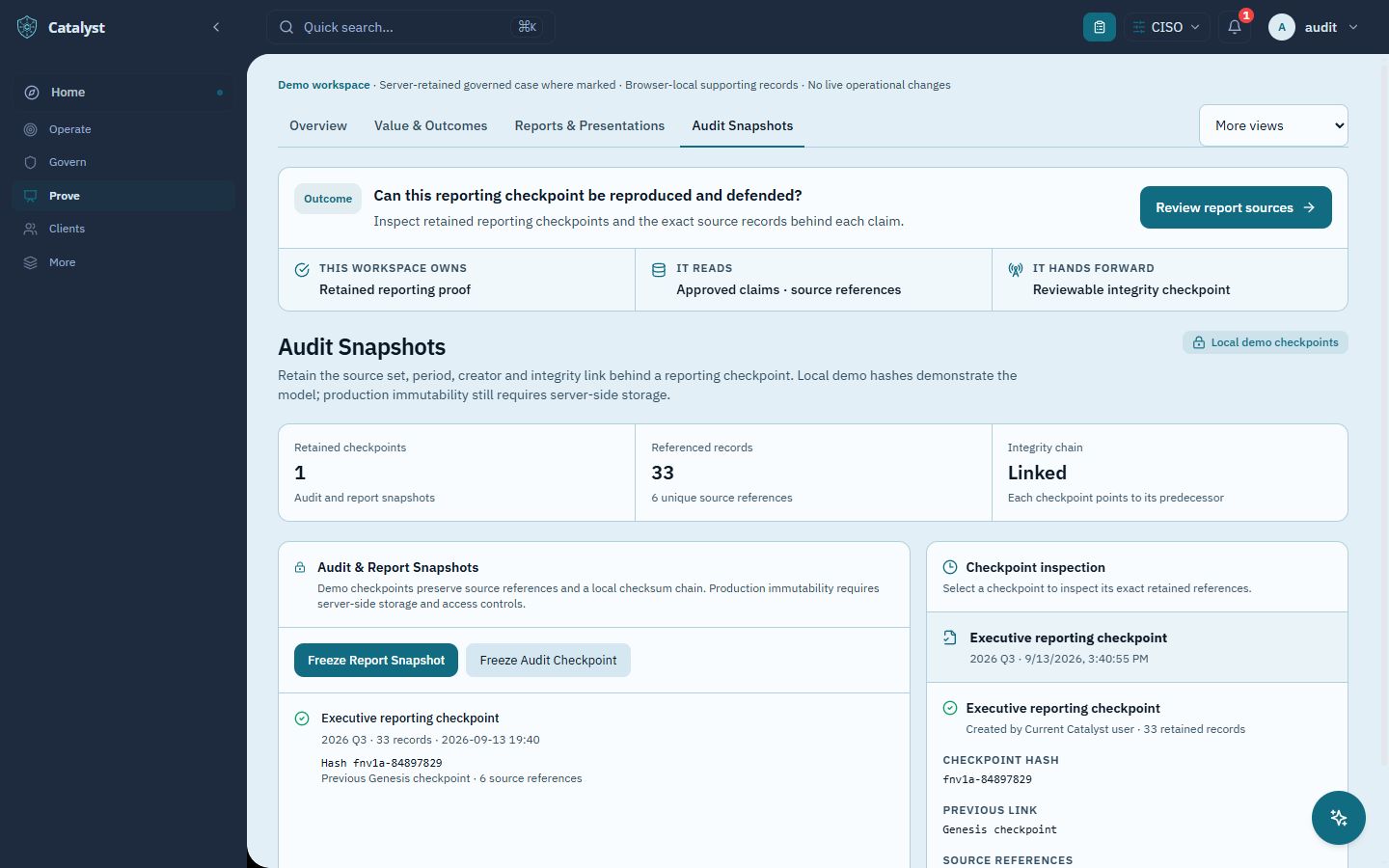
Executive reporting and reproducible audit snapshots
Recommendations do not become operational changes without explicit authorization and the required approvers.
Source references, import times, evidence freshness, confidence, approvals, conditions, and measurement periods remain attached.
Catalyst does not need prompts or responses merely to calculate AI cost, allocation, utilization, or value.
Production architecture is designed around tenant-isolated data, permissions, connector scopes, and environment-specific policies.
Reproducible reporting proof
Catalyst retains the reporting period, creator, record count, integrity link, and exact source references behind a checkpoint. The demonstration shows the operating model; production immutability requires validated server-side storage and access controls.
Production path
Before production use, the deployment and its controls are agreed, tested, and evidenced. These are the ten decisions and exit tests Catalyst expects a pilot plan to contain.
Product views across this site use demonstration records. We do not publish real security data, ours or anyone else's.
Agree deployment, region, tenancy, identity, and data handling.
Approve each connector scope, secret owner, and action boundary.
Exercise isolation, authorization, recovery, logging, and rollback.
Accept documented evidence against explicit go, extend, or stop criteria.
Agree the hosted topology, network boundary, region, environments, and any private connectivity.
Required exit evidence
An approved architecture diagram, named service owners, and separate demonstration, pilot, and production boundaries.
Inventory stored data, processing locations, subprocessors, and any cross-region transfer.
Required exit evidence
A signed data map stating what Catalyst stores, where it is processed, how long it remains, and how deletion is verified.
Confirm encryption in transit and at rest, key custody, rotation, and revocation responsibilities.
Required exit evidence
Documented cipher and key controls, a completed rotation test, and an explicit decision on provider-managed or customer-managed keys.
Bind every request, record, connector, and policy evaluation to an organization and environment.
Required exit evidence
Negative cross-tenant tests, authorization tests, and an evidence package showing that one tenant cannot read or change another tenant's records.
Connect the organization identity provider and map groups to Catalyst roles and decision authority.
Required exit evidence
SSO, MFA and conditional-access behavior, joiner and leaver handling, privileged-role review, and a tested emergency-access procedure.
Scope each connector to the minimum systems, records, operations, and environments needed for the scenario.
Required exit evidence
A reviewed permission manifest, read-only defaults, protected secrets, and separate written authorization for any action-capable connector.
Set the retention period for evidence, decisions, policy versions, tickets, receipts, and verification records.
Required exit evidence
Searchable and exportable audit history, synchronized timestamps, access logging, and an immutability test for records designated as final.
Agree recovery-point and recovery-time objectives, backup ownership, and failure communications.
Required exit evidence
A successful restore test, documented dependencies, and a recovery runbook with named escalation owners.
Threat-model the pilot architecture and test code, dependencies, secrets, access controls, and exposed interfaces.
Required exit evidence
Resolved critical findings, an accepted remediation plan for lower findings, and a production security review signed by both teams.
Define success before connecting production records, including accuracy, access, resilience, operating ownership, and measurable outcome.
Required exit evidence
Signed acceptance criteria, tested incident and rollback paths, approved data export and deletion, and an explicit go, extend, or stop decision.
The exact deployment choices depend on your environment. The evidence standard does not: the control must be documented, tested, owned, and accepted before production use.
Proof standards
Partner names, quotes, or outcomes are shared only with explicit approval.
The working demo and production prerequisites remain visibly distinct.
Estimated opportunity and verified outcome remain separate throughout the evaluation.
Safe operating defaults
Evaluate with a real scenario
We will show the boundary between the current working product and the production validation your environment requires.
Book a guided product demo