01
Identity
Is this a registered agent with an accountable owner and a verifiable workload identity?
Authority stage · Catalyst Agent Gate
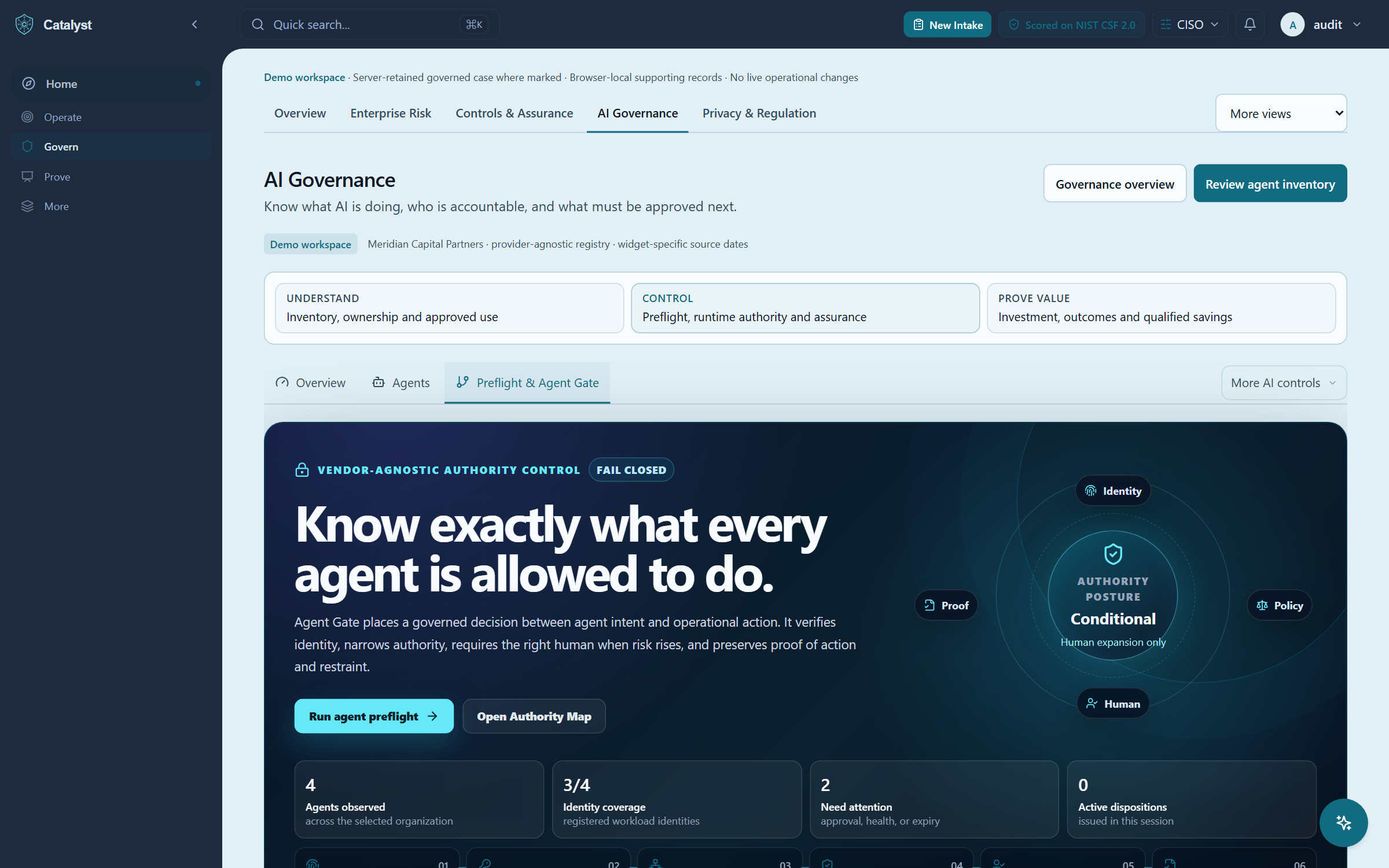
Within Catalyst's accountability chain, Agent Gate is the authority checkpoint for AI actions. It checks who the agent is, what it wants to do, which evidence supports the request, and who may approve it. The result stays connected to delivery and outcome records.
Requested operation
Policy holds this exact scope. No tool call is released by the evaluation.
A working demo of decision logic, not evidence of a live enforcement adapter.
Test the proposed agent and environment before deployment.
Name the approvers and issue bounded authority.
Record purpose, permissions, limits, supervision, and expiry.
Fail safely at the control point and return a receipt.
Watch for drift, then revoke or reapprove when conditions change.
01 · Preflight
Preflight evaluates identity, requested capability, data boundary, environment, policy, and required authority before deployment or an action-capable route. It uses control metadata, not the agent's prompts or responses.
Is this a registered agent with an accountable owner and a verifiable workload identity?
Does the request fit an approved scope, expiry, call limit, cost ceiling, and delegation boundary?
Is this operation registered for the agent, environment, tool, and data class?
Do risk, data sensitivity, estimated cost, and lifecycle status permit this route?
If authority is missing, which named owners must approve this exact request?
What was requested, why was it held or denied, and which conditions governed the result?
02 · Authorize
A lease can bind one agent to one capability, operation, environment, data class, budget, call count, delegation depth, and expiry. If identity assurance fails or scope is exceeded, the request is denied. Write actions and restricted data go to named approvers when authority is missing.
The source signal and reviewed evidence stay linked to the request. A held result can become a Pending Decision for the same scope. Approval produces a Catalyst Authority Grant. Delivery preserves a Decision Receipt, and the measured result becomes an Outcome Record. The gate evaluation never performs the action itself.
03 · Define the operating envelope
A Catalyst-issued assurance record defines the purpose, permissions, limits, supervision, and expiry under which an agent may operate. It remains valid only while those conditions remain true. It is not an independent certification, warranty, or insurance policy.
Assurance record AGA-MER-001
Illustrative Catalyst-issued record from the working product concept. Assurance is scope-bound and conditional, not a permanent trust badge or external certification.
Record the exact purpose, data, tools, environments, actions, limits, and human supervision that define acceptable operation.
Suspend and review the assurance record when the model, owner, tools, data access, behavior, policy, or enforcement path changes.
Package tested controls, revocation, incidents, authority receipts, and performance evidence for independent review by a licensed assurance or insurance partner.
Catalyst records operating conditions and control evidence. It does not warrant agent behavior or issue insurance. Any external certification or financial policy would require separate evaluation by the responsible licensed organization.
04 · Enforce at runtime
A production pilot does not stop at a policy result. It must prove how identity is bound, where the decision is enforced, how revocation propagates, and which execution receipt returns to Catalyst.
Verify the agent and workload identity against the tenant and environment before policy is evaluated.
Pilot evidence: signed identity assertion and negative impersonation testWhen identity, policy, evidence, or Catalyst availability is insufficient, no action-capable route is released.
Pilot evidence: timeout, outage, and stale-authority testsA lease ends on expiry, revocation, owner change, scope change, or a defined risk condition.
Pilot evidence: measured revocation propagation and blocked replayThe enforcement point returns the decision identifier, effective conditions, operation, result, and timestamp.
Pilot evidence: receipt reconciled to the external system and audit record05 · Assure continuously
Continuous Behavior Assurance compares observed control metadata with the agent's approved operating envelope. Catalyst does not need to collect prompts or responses to recognize a material change in authority, behavior, or outcome.
Is the agent still performing the job that was approved?
Is it attempting new actions, tools, or execution paths?
Is it reaching a new data class, system, environment, or tenant?
Did the agent, owner, workload identity, or credential change?
Is it invoking agents or descendants outside the approved depth?
Is retained context moving beyond its approved purpose or boundary?
Did calls, retries, latency, spend, or failure behavior materially change?
Did quality, security, service, or human-review results fall outside limits?
Record the changed condition and affected scope.
Separate expected variation from material drift.
Hold only the unsafe capability or authority path.
Route material changes to the named human authority.
Recheck the source and preserve the assurance record.
Catalyst recommends and records the response. Automatic operational containment requires an explicitly configured enforcement point and policy.
Portable by design
Catalyst uses a neutral request and decision model. Identity, runtime, enforcement, and evidence adapters bring context from the systems you already use.
Entra, Okta, CyberArk, another OIDC issuer, or an attested workload identity.
Commercial, open-source, internally built, cloud, edge, and multi-model agents.
A runtime hook, sidecar, proxy, API gateway, or connector pre-flight control.
Audit streams, SIEM records, tickets, catalogs, billing exports, and source references.
Deterministic policy evaluation, held requests, linked decisions, lease simulation, and readable reasons.
Identity verification, signed tenant-bound leases, durable audit, and a deployed enforcement adapter are configured and validated for your environment.
Bring an agent action you would not want to approve blindly. We will show the decision path and what a production control point would need to enforce.
Book an Agent Gate demo