Priority and SLA
Materiality, client tier, due dates, dependencies, and service thresholds drive one ranked queue.
Managed governance services
Catalyst gives managed governance teams one command system for multi-client priorities, service commitments, evidence, decisions, delivery capacity, economics, and reporting.
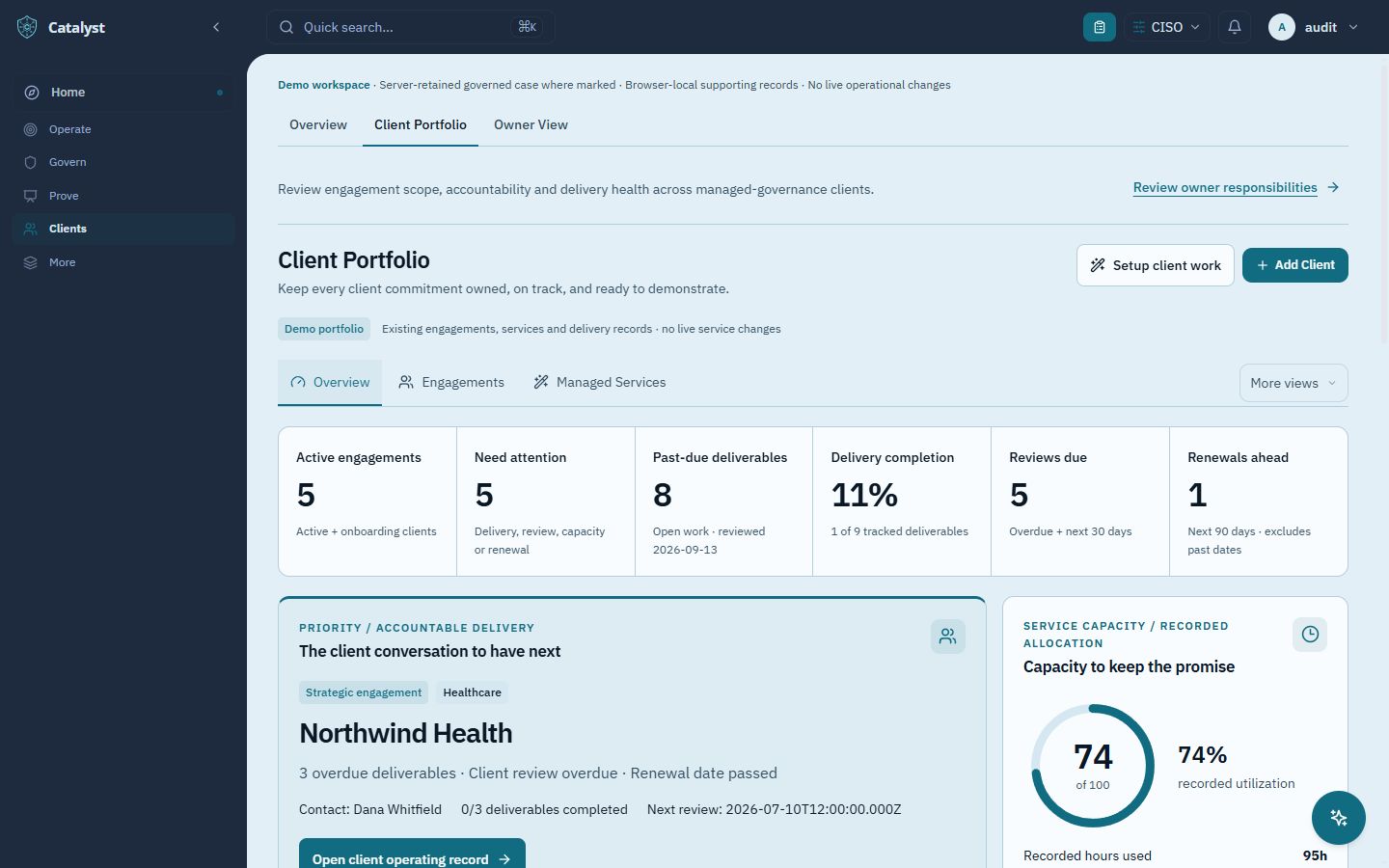
The service command system
Operators see the queue. Service leaders see commitments and capacity. Clients see the decisions and outcomes that matter. All three views resolve to the same underlying records.
Materiality, client tier, due dates, dependencies, and service thresholds drive one ranked queue.
Named accountability, workload, specialist coverage, handoffs, and escalation paths stay visible.
Effort, scope, margin signals, expansion opportunities, and measured client value remain qualified.
Reviews and reports are generated from the same evidence, decisions, tickets, and verification records.
Client operating cadence
Catalyst structures the operating rhythm without forcing every client into the same control set, technology stack, or risk appetite.
Triage new signals, evidence requests, expiring authority, breached thresholds, and decisions approaching SLA.
Review client priorities, approval blockers, tickets, ownership gaps, capacity, and outcome measurements.
Publish an evidence-backed view of posture change, commitments delivered, economics, exceptions, and decisions required.
Reassess material risks, roadmap investment, service scope, governance maturity, and executive outcomes.
A focused work queue with evidence, decision, ticket, due date, client, and next action already attached.
A portfolio view of client health, SLA risk, delivery capacity, commitments, economics, and expansion opportunities.
A concise owner view of what changed, what requires authority, what was delivered, and what measurable result followed.
A measurable service promise
Define the client obligation, owner, scope, service level, and evidence requirement.
Preserve decision conditions and execution status through the service cadence.
Compare baseline and observed result using an explicit measurement method.
Show what changed, what remains open, and what the service achieved from one record.
The design-partner program maps Catalyst to your delivery model, your systems, and a result your client will recognize.
Request a design partner conversation